I Wear My Sunglasses At Night

Because as the ancient Greeks said, sunglasses are the window to the soul

Recently Nick and I decided that each week we would riff on a chapter from our recently published book, thinking it would be a great way to explore in a little more depth the ideas that we had intentionally stripped down to their essentials to create a fun, light read. This looked like it would be a great idea, but this week I discovered a little flaw in our thinking, which is that the next chapter up for discussion would be “Buy a really nice pair of sunglasses”.  How on Earth do you talk about sunglasses all week? Ironically, this is a snag that we could have avoided, if only we had read the next chapter, which is “Write a 250-year plan”. It also highlights something that Nick and I talk about a lot, which is the idea of “Mastery” vs. “Foolery”. Nick often applies (with considerable success) the principles of mastery in his pursuits, and for my part, I’m often diving headlong into something with only the most vague of plans, i.e.: being a fool. These are both valid approaches, and one big difference is that while the former will lead to fewer outright failures, the latter will lead to surprise and innovation that would be unlikely with a planned, disciplined approach.

But back to the earlier question, which was “how on Earth do you talk about sunglasses all week?” The answer is probably “you don’t”, because the chapter in the book is really about getting out of your comfort zone, not sunglasses per se. But in the time-honored tradition of my own pursuit of foolery, I’ve been reminded that while better planning doesn’t hurt, you can still have fun and turn adversity into opportunity. So below are some thoughts that ARE in fact specifically about sunglasses.

If you think the decisions you make about sunglasses are unimportant, you’re missing something very important about life and personal expression. As the ancient Greeks said, “sunglasses are the window to the soul”. Okay, they never said that, but sunglasses ARE in fact a sort of window to the soul, or at least some venetian blinds, in the case of Kanye West. If your choice of shades goes beyond the basic practical requirements of say, sporting gear, you are immediately revealing something about yourself, whether it’s that you’re staid and conservative, a spy, or maybe a rock star. Imagine any of the celebrities below without their sunglasses, and you’ll pretty quickly realize that without them, many of them are really nobody. So next time you pass the sunglasses rack, why not have a little fun exploring who you are or who you want to be?

Do you sometimes suspect that maybe you’re trapped in The Matrix? If so, these knock-offs of the shades Keanu Reeves’ character wore in the Matrix are only about ten bucks.

Matrix Shades

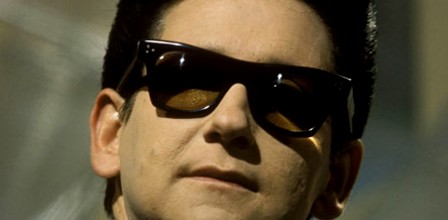
Can you imagine Roy Orbison without his signature Wayfarers? An interesting fact about Orbison’s preference for wearing sunglasses on stage is that it was actually the result of accidentally forgetting his regular glasses for a show, and being forced to wear his prescription Wayfarers. A great example the sometimes positive results of the unplanned.

If you want to look like a rock star, there are tons of options, but if you want to look like a rock star named BONO, you’re going to have to cough up a few hundred bucks for a pair of Bulgaris. It’s interesting to note that Bono’s propensity for wearing sunglasses 24/7 is a result of the fact that he has problems with eye irritation that actually necessitate it.

Bono

You may never actually want to look like Lady Gaga, but that’s not a concern if you wear these shades, because they’ll make you look more like Mickey Mouse. The real things are a $350 Linda Farrow model, but you can pretty much capture the effect with these shades for $9.95

So at the end of the day, I’ll be wearing my sunglasses. Because….

See? Even Corey Hart wears Wayfarers.

About Ian

Ian is a media consultant, writer, musician, and budding public speaker with an eye on being the next Ellen. Ian's interest in helping others find success and happiness stems from his experience with events planning and media consulting with organizations like Interfluence.com and the Kenya/US NGO Amara Conservation from 2000-2008, which taught him how little we all know about what we're really doing. From 2008 until April of 2011, Ian wrote for and maintained the site DissociatedPress.com. Ian learned long ago that the journey to success may take occasional detours, and often eschews the road map in favor of taking in life's scenery. His first business venture was a small telecom company in the late 1980's, but subsequent ventures included pursuing a pop music career, screenwriting, and the foodservice and retail employment that often follows such pursuits. After struggling with addiction for years, Ian is happily embracing recovery and the clarity it brings.